4 Equipment
It’s important to bring the right equipment along to any sea kayak trip, and we’ll discuss what to bring before we head off on the course trips. The club can provide most specialist equipment, although you might want to acquire some warm and windproof kit - Decathlon is a good place to buy cheap decent kit, and there’s a store in Cambridge.
People who get hooked on sea kayaking often find themselves acquiring shiny new equipment rather faster than they anticipated. If you’re thinking about making purchases, why not ask for opinions from the course participants and coaches? Having used, worn out and broken a lot of kit over the years, we can hopefully provide some useful insights.
4.1 What to wear
Sea kayakers will choose what to wear depending on weather conditions. There’s often a balance to be struck between dressing to be comfortable paddling and dressing for immersion in case things go wrong.
Sea kayakers will typically wear:
A buoyancy aid. It’s useful to have one with pockets.
Spraydeck
Helmet - if paddling near rocks on in the surf. Given that opportunities for rockhopping and the need to land through surf can’t always be anticipated, many sea kayakers choose to always carry a helmet in or on their boat.
Decent footwear, suitable for scrambling over rocks with heavy boats. Most of us use neoprene boots (as for many items of kit, Lomo is excellent and good value).
Shell layer - a wind and waterproof outer layer. Either separate cagoule (cag) for the upper body and trousers, or an one-piece suit. Choice depends on weather, as there’s a compromise to be struck here between waterproofing and venting. In cold conditions, or if expecting to get wet, a drysuit is the best choice. However, most of the time, I’ll prefer to wear dry trousers with a separate cag. Sea cags sometimes (but not always) have latex wrist seals, but often don’t have seals at the neck. If it’s really hot, shorts can be the best option - but I’d always carry something warmer in the boat. For those starting out, waterproof walking trousers are a good choice to keep wind off legs. A club cag, or even a light walker’s waterproof can be used on the top half. Clearly, those won’t keep you dry if you swim, but carrying spare clothes can mitigate the risk somewhat.
Warm layers - underneath the shell layer, kayakers wear layers to keep warm. It’s important that these layers work when wet, so close fitting clothing is better, and cotton should be avoided. A range of thin layers gives more options than one thick layer.
Spare clothing - always take some spare clothes in the boat in case of an unexpected swim. Clearly, you’ll want to carry more clothing if you’ve begun the day dressing light because it’s warm. Bear in mind the worst case scenario of ending up wet and cold on a beach you didn’t expect to get stranded on.
Hat - warm hats are great for flexibly regulating temperature. Neoprene hats can work well too.
Gloves - some people dislike paddling in gloves, whilst others seem to prefer it. Various options are available from full neoprene gloves to palm-less gloves and ‘pogies’ that fit over the paddle shaft.
Towline - everyone in the group should have a towline and know how to use it.
Knife - always have a knife on hand in case you need to cut an entangled towline. Also useful for cheese at lunchtime.
Whistle - for attracting attention
Sun hat, sunglasses, sunscreen - because we do sometimes get nice weather!
4.2 Boat designs
The modern British sea kayak has been developed to be seaworthy in a wide variety of conditions. It is long enough to be fast, but retains some maneuverability. It has a number of watertight compartments with sealed hatches. Its decklines and elastics allow kit to be stowed and the boat to be handled during rescues. It typically has a fairly low profile above the water to reduce windage, but has a raised bow to cut through waves.
Sea kayak manufacturers include:
P&H http://www.phseakayaks.com - part of the Pyranha group
Valley http://www.valleyseakayaks.com - a longstanding maker of sea boats
Sea Kayaking UK https://www.seakayakinguk.com - run by Nigel Dennis on Anglesey
Rockpool https://www.seakayakinguk.com - another Anglesey based firm
Tiderace http://www.tideraceseakayaks.co.uk - recently acquired by Nelo, some innovative designs
Northshore http://www.northshoreseakayaks.co.uk - well priced range of boats
Boats are normally made from either composite or plastic:
Composite construction involves combining mats of glass, diolen, kevlar or carbon fibres with epoxy resin to produce a very strong and stiff material. These boats are stiff and can be made light - although low weight designs are rather expensive. Composite boats are more expensive than plastic models. Whilst composite boats are easier to damage, they are also easy to repair. Because each boat is virtually a one-off, a degree of customisation (e.g. in bulkhead position or deck fittings) is often possible.
Plastic boats are moulded in polyethylene. More modern designs use multi-layer constructions, with a foam core to reduce weight and increase stiffness. These boats are lower cost and more robust than composite - a good choice for playing near rocks or dragging around. They do have a degree of flex, although many paddlers aren’t bothered by this.
A range of boat designs exist, each with their own characteristics. The images below show a small selection of currently available designs to illustrate some of the options.
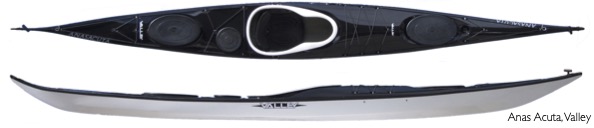
The Inuit, the kayak hunters of Greenland and the Arctic, made their boats from seal skin stretched over wood frames. Early UK designs in fibreglass, like the Anas Acuta, copied these closely, retaining the hard corners in the hull shape.
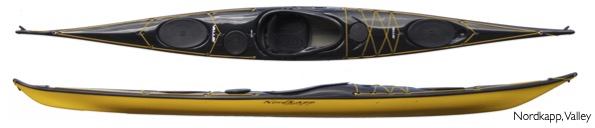
These designs were refined into classic designs like the Nordkapp - boats designed to carry expedition loads and handle rough conditions.
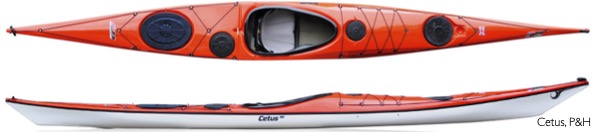
Modern expedition boats like the P&H Cetus, Valley Etain and Northshore Atlantic are typically more stable and easier to paddle than the older boats, but are designed for much the same role.
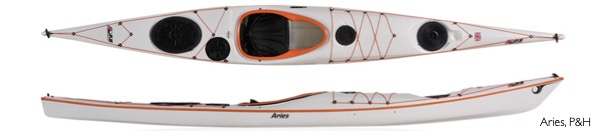
Whilst an 18 foot long boat is perfect for expeditions and paddling in a straight line, it is less well suited to exploring rocky shorelines and surfing tide races. For many sea kayakers who mostly paddle on day trips to rock hop and play in races, shorter boats around the 16 foot mark are a better compromise. Sea Kayak UK’s Romany is a classic design in this category. More modern boats have incorporated flat bottoms, harder chines and reshaped bows like the P&H Aries and the Tiderace Xcite.
More recently, a series 16 foot sea kayaks more focused on general day paddling (and a little less on playing) has emerged. These include the P&H Volan/Leo and the Valley Sirona. These boats are an excellent compromise for many sea kayakers,
Extreme ocean playboats have shrunk to around 14 foot long, and become less suitable for journeying - the P&H Hammer being one example.
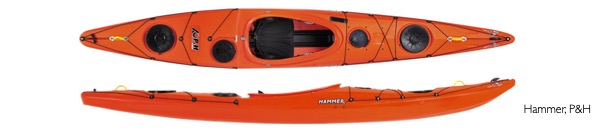
Another strand of kayak development has focussed on boats that simply go faster. Designs like the Valley Rapier were designed for pure speed and sea racing, compromising handling and stability. More modern boats, led by the Rockpool Taran have more predictable handling and somewhat improved stability.
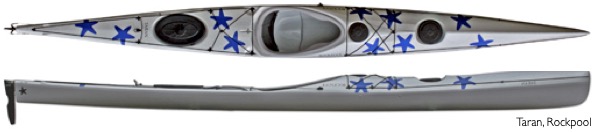
As well as race use, they have been used for expeditions, breaking records for circumnavigations of Ireland and the British Mainland. Some say that the Taran and similar boats are a vision of the future of the expedition sea kayak.
4.3 Paddle designs
The Inuit used long slender wooden paddles. This was likely due to the materials (driftwood) and fabrication techniques available, but some modern paddlers enjoy using ‘greenland sticks’. They require a different technique compared to standard ‘euro’ paddles.
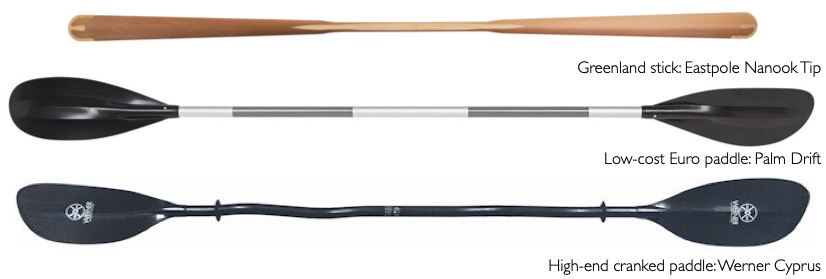
Paddle materials vary, depending mostly on the cost of the paddle. Shafts for cheap paddles use aluminium, although carbon and fibreglass composites are becoming increasingly widespread at many price points. Blade materials vary from injection moulded plastic for cheap paddles to fibreglass and carbon composites at the high end.
Paddle shafts can be straight, or ‘cranked’ with a bend that places the wrist at a more neutral angle. Some paddlers find these cranked shafts more comfortable to use, or find that they reduce the incidence of injury. Sea kayak paddles almost always split into two sections to enable them to be carried as spares. The joint generally allows feather to be adjusted and often allows length to be varied by around 10 cm.
Paddle blades come in a range of shapes. The main categories are:
Low angle paddles - long and thin - intended for a ‘low angle’ stroke where the top hand is kept around shoulder height or lower.
High angle paddles - shorter and fatter - are intended for a more efficient ‘high angle’ stroke where the top hand comes to forehead height.
Wing paddles - originally designed for racing, these paddles provide an impressive level of power if used correctly. Whilst they can be challenging to use in rough water, some advanced paddlers find them excellent for covering long distances on the sea.
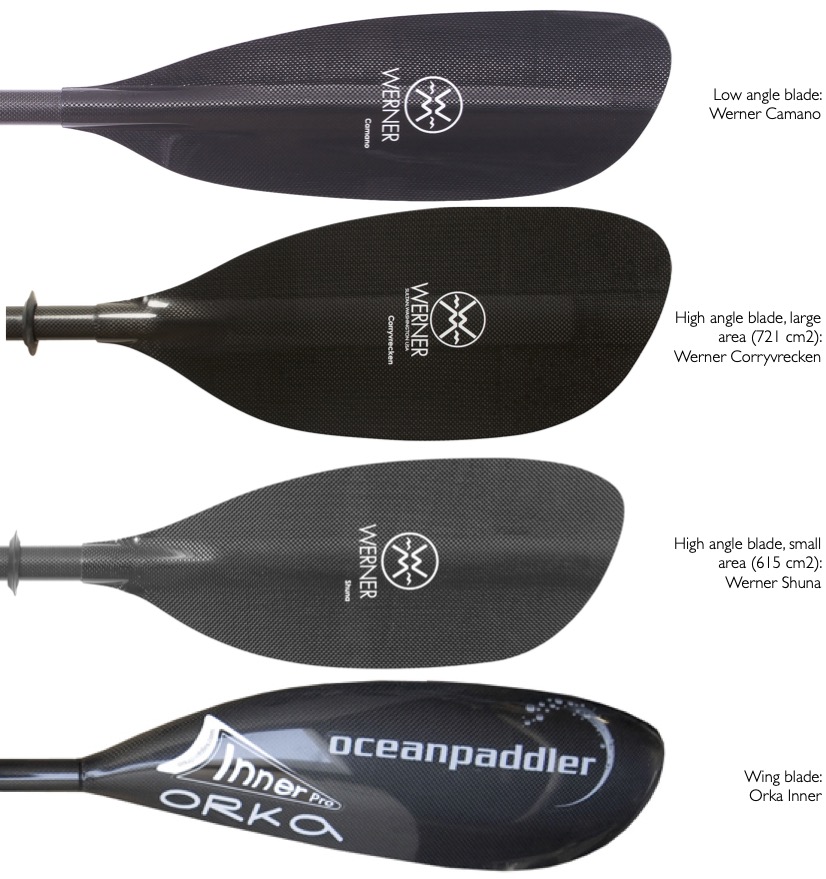
Paddle length and area are important as they affect the force that the paddler applies to the paddle. Using overly long or large blades can cause fatigue or injury over long days.
Some kayakers use paddle leashes to attach the paddle to their boat. This prevents the paddle being lost during swims and rescues. However, they are unusual in the UK due to the the potential for the paddler to become entangled in the leash in rough water.
4.4 Safety kit
What and how much safety kit to carry depends on the conditions, the type of paddle that you’re doing and whether you’re responsible for other people. An advanced water sea leader operating in a remote corner of Scotland in winter is going to carry more kit than a member of a group being led on a day paddle around Cornish beaches in high summer.
I’d suggest the following as a start point:
Spare clothing.
Food (lunch, snacks) and drink (water bottle and/or thermos flask)
A means of summoning external assistance e.g. VHF, PLB, phone, flares - ideally carry more than one option!
Towline - everyone in the group should have a towline and know how to use it.
Knife - always have a knife on hand in case you need to cut an entangled towline. Also useful for cheese at lunchtime.
Whistle - for attracting attention
Compass - hiking baseplate compasses are ideal
Basic first aid kit - to treat simple bumps and scrapes and including any personal medication
Basic repair kit - ‘Flex Tape’ has become my primary approach to repairing things, as it works so well in the wet. Cable ties are always useful, and it’s good to have tools to tighten the bolts on your boat.
Exposure bag or emergency shelter - for treating hypothermic casualties. Exposure bags come in a variety of designs from the traditional orange plastic bag to modern advanced designs like the ‘Blizzard Bag’ that reflect heat and open out to create air pockets that act as insulation. Emergency shelters are larger, such that you can fit an entire group in - like a tent but without the poles.
4.5 Boat repair
A range of methods have been developed over the years to repair sea kayaks whilst on trips. If things go badly wrong, it can be important to carry out an initial repair at sea before being able to return to land for a more permanent fix. Howard Jeffs is considered something of an expert, and his Youtube channel is a useful resource.
Having tried a number of the traditional approaches, and a few new ones, I’ve found that ‘Flex Tape’, a strong, wide tape with a rubber adhesive, is the best approach to tackling most kayak damage. If you’ve not seen them before, the marketing videos with the inimitable ‘Phil Swift’ are worth watching.