CCC Sea Kayak Course 2026 Handout
1 Introduction
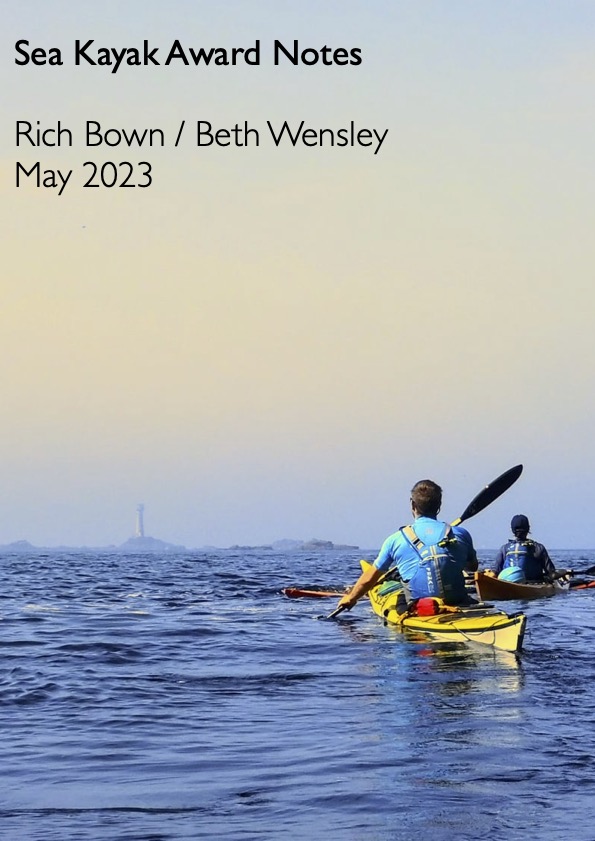
Welcome to the CCC beginner’s sea kayak course! The course aims to take beginner sea kayakers to the point where they can:
Join intermediate level club trips (see our trip designations here).
Plan and undertake their own trips on the sea, with peers, in simple conditions
We’ll (loosely) we working with the syllabus of the British Canoeing Sea Kayak Award and we’re hoping that all participants reach a level where we can sign them off for this award.
These notes are based around the Sea Kayak Award syllabus and are intended to serve as a reminder and reference for the material that we’ll be covering. There’s no need to read it in detail (or at all!), but you might find it helpful if you’ve forgotten something we’ve covered, missed a session, or are practicing the skills by yourself.
1.1 Syllabus
The Sea Kayak Award is intended for paddlers who can safely plan and undertake trips on the sea in winds up to force 3 and tides up to 1 knot. The award syllabus is available online at the British Canoeing Awarding Body website, and is summarized as a set of skills below. It’s important to note that, whilst the syllabus does contain some paddling skills, the majority of it covers the knowledge required to safely plan and undertake a day’s paddling on the sea. In particular, it’s hard to over-state the importance of being able to synthesize information from maps, guidebooks, tide tables and weather forecasts to come up with a good plan for the day.
1.1.1 Location and Planning
Create a plan for the day, considering wind, tide, swell, other water uses etc.
Obtain and describe a wind forecast
Understand the impact of wind (including local / topographic effects) on sea kayakers
Obtain and describe a swell forecast
Obtain times of high and low water and describe the effect of tides on plans
(At a basic level - be able to forecast tidal streams)
Be able to find and evaluate access and escape options
Be able to synthesize the information described above to formulate a plan for a safe day’s sea kayaking
1.1.2 Kit
Decide what to take, and describe other options (e.g. for winter). Describe how you’d repair a boat.
Decide what to wear, describe other options
Describe different boat designs, their intended uses and how they feel to paddle
Describe different paddle designs, their advantages and disadvantages
Know what safety kit to take sea kayaking
Describe how to perform a simple boat repair
1.1.3 Safety
Deal with a cold casualty, summon help (identifying location), group skills, towing
Know how to avoid, recognise and treat hypothermia and hyperthermia
Describe equipment and approaches for summoning outside help
Be able to navigate along a coastline
Be able to work around other water users, including large vessels
Be able to communicate effectively with your paddling group
Be able to tow both an individual and a raft with an incapacitated paddler
1.1.4 Dry(er) Skills
Paddle forward efficiently, including in wind. manoeuvre effectively in confined spaces
Demonstrate effective and efficient forward paddling
Be able to maintain direction in winds up to force 3
Demonstrate effective and efficient turning of a sea kayak
Be able to move the boat sideways
Demonstrate entry and exit of confined spaces (rockhopping)
1.1.5 Wetter skills
Brace, self rescue, assisted rescue
Demonstrate a brace with the boat off-balance
Demonstrate a self rescue in simple conditions
Demonstrate an assisted rescue as victim and rescuer, including dealing with loose kit